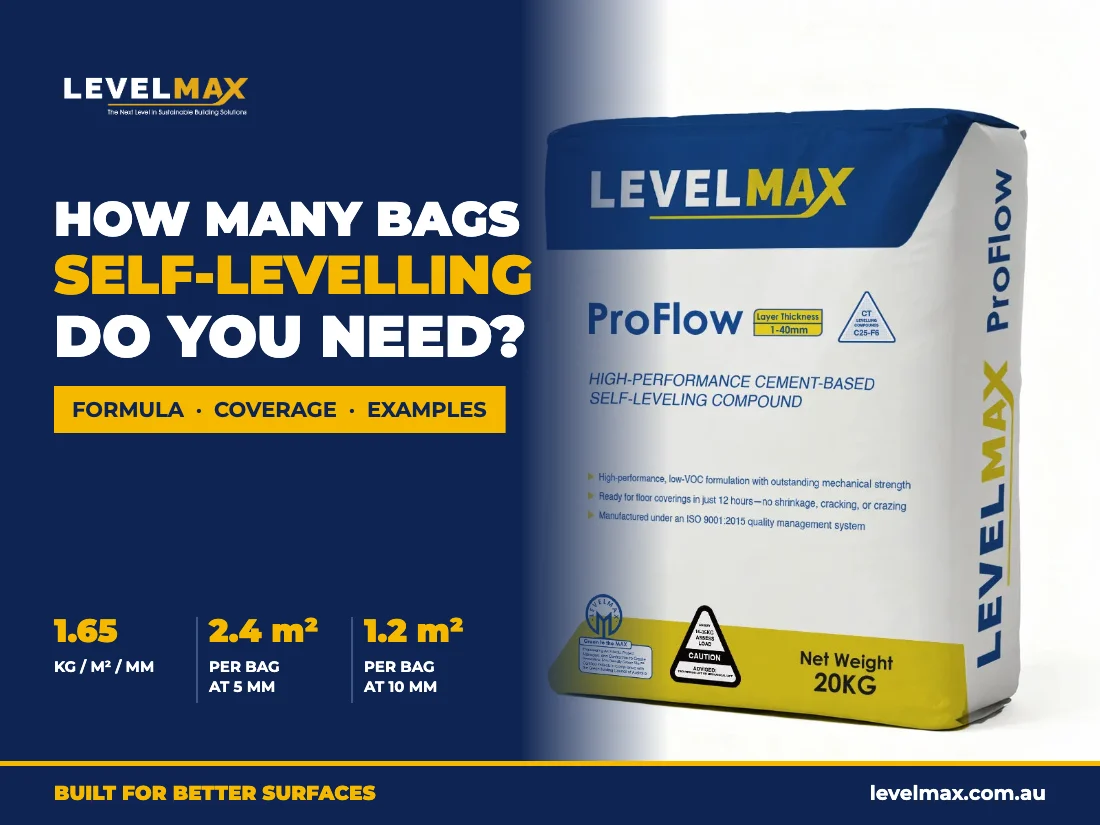
For LEVELMAX ProFlow, allow about 1.65 kg of powder per square metre for every millimetre of thickness. A 20 kg bag covers about 2.4 m² at 5 mm or 1.2 m² at 10 mm. Multiply your floor area by the average thickness, apply the formula below, and round up to whole bags.
ProFlow bag calculator
Enter your floor area and the average thickness to estimate how many 20 kg bags of ProFlow to order.
Based on 1.65 kg per m² per mm of thickness. ProFlow is applied 1–40 mm per coat; confirm quantities for your site with our team.
The formula
Bags = area (m²) × average thickness (mm) × 1.65 ÷ 20
Round up to the next whole bag, then add an allowance for the substrate profile and site wastage.
Example: a 20 m² room at an average of 5 mm needs 20 × 5 × 1.65 = 165 kg, which is 8.25 bags, so order 9 bags plus your allowance.
Coverage per 20 kg bag
| Thickness |
Coverage per bag |
| 5 mm |
2.4 m² |
| 10 mm |
1.2 m² |
| 20 mm |
0.6 m² |
| 30 mm |
0.4 m² |
| 40 mm |
0.3 m² |
Bags for common floor areas
Bags of ProFlow before any wastage allowance, rounded up:
| Floor area |
3 mm |
5 mm |
10 mm |
| 10 m² |
3 |
5 |
9 |
| 20 m² |
5 |
9 |
17 |
| 50 m² |
13 |
21 |
42 |
| 100 m² |
25 |
42 |
83 |
How to work out the average thickness
The quantity depends on the average depth across the floor, not the deepest low point. Using the deepest point for the whole room will over-order; using the shallowest will leave you short.
- Find the high point of the floor; that is where the compound will be thinnest.
- Measure how far below that level the floor sits at regular points across the room.
- Average those measurements and add the minimum thickness you want over the high point.
How thick can you pour?
ProFlow can be applied from 1 mm to 40 mm in a single coat. For greater depths, apply it in layers: let each layer set and dry, then prime it again before pouring the next. Over underfloor heating, allow at least 5 mm above the highest point of the heating element.
Before you order
- Prime every substrate. Use Primer X Concentrate on concrete and screeds, or Primer X Timber on timber subfloors.
- Check slab moisture. Self-levelling compound is not a moisture barrier; test to AS 1884 first.
- Plan the pour. Each bag has 20–30 minutes of working time once mixed, so make sure you have enough people and mixing capacity for the area.
Related reading
For project quantities, send the floor area, average thickness, substrate and floor covering to our Sydney team. Call 1300 601 898 or request a trade quote.