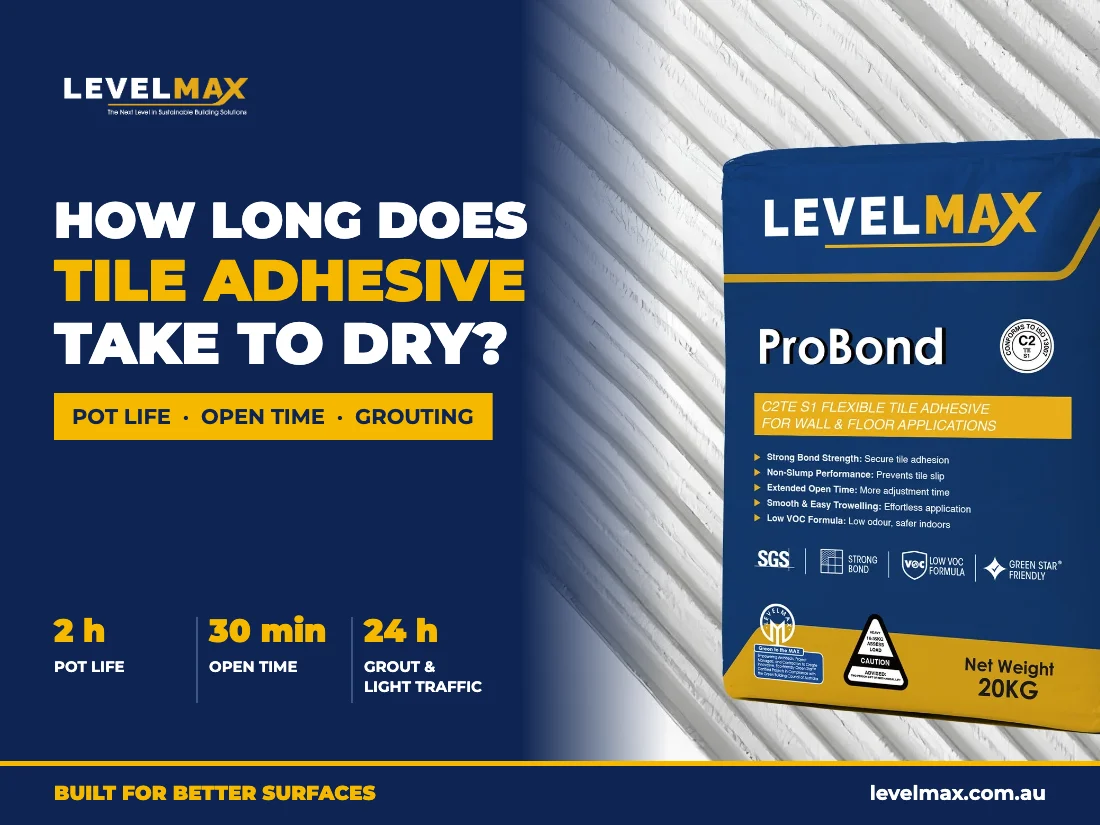
For a cement-based tile adhesive such as LEVELMAX ProBond, plan on 24 hours before grouting or light foot traffic under normal conditions (23 °C and 50% relative humidity). Cold, humid or poorly ventilated sites, thick adhesive beds and non-absorbent surfaces can all push that out further.
“Drying time” is only one of several timings on a tile adhesive bag, and confusing them causes a lot of failed tiles. This guide explains each one and what changes them.
The four timings that matter
| Timing |
What it means |
ProBond C2TE S1 |
| Pot life |
How long mixed adhesive stays usable in the bucket |
Approx. 2 hours |
| Open time |
How long spread adhesive can still accept a tile and bond properly |
Approx. 30 minutes |
| Grouting |
When joints can be grouted |
After 24 hours |
| Light foot traffic |
When the floor can be walked on carefully |
After 24 hours |
Pot life is not open time
Pot life is about the mix in the bucket. Open time is about adhesive already combed onto the wall or floor. Adhesive can still be fine in the bucket while the ridges on the floor have started to skin over.
To check open time on site, press your fingertip into the combed adhesive. If adhesive transfers to your finger, you can still lay tiles into it. If it does not, scrape it off and spread fresh adhesive. Never re-mix adhesive with extra water to extend its life.
The “E” in C2TE S1 means extended open time: ProBond still achieves at least 0.5 MPa tensile adhesion when tiles are placed 30 minutes after spreading.
What slows tile adhesive drying?
Cement-based adhesive sets through a chemical reaction with water, and that reaction slows down in poor conditions. Expect longer times when:
- It is cold. Low temperatures slow setting noticeably. Do not apply ProBond below +5 °C or above +35 °C.
- Humidity is high or the room has little air movement.
- The adhesive bed is thick, for example when back-buttering large-format tiles over an uneven floor.
- Both surfaces are non-absorbent, such as porcelain tiles over existing glazed tiles. Water has nowhere to go except through the joints.
If you need to tile quickly, fix the cause rather than rushing the adhesive: level the floor first so the bed can be thinner, and keep the room within the application temperature range.
Does the substrate need to cure first?
Yes. The adhesive can only perform as well as the surface beneath it.
- New concrete: cure for at least 4 weeks before tiling
- New render: at least 7 days
- Very smooth, dense concrete (above about 35 MPa): grind or scarify to create a key
- Existing tiles (internal dry areas only): grind off about 80% of the glaze
If the floor is uneven, prime it with Primer X Concentrate and level it with ProFlow self-levelling compound first. ProFlow takes floor coverings from 24 hours, so allow for that in your programme.
How to get the timings you expect
- Mix correctly. Add a 20 kg bag of ProBond to about 5.2 L of water, mix with a drill mixer, let it stand for around 5 minutes, then remix.
- Spread only what you can tile within the open time. Flatten a thin coat first, then comb with the notched trowel.
- Back-butter large tiles so the adhesive covers both surfaces, and press each tile firmly into place.
- Choose the right notch. A 6 mm square notch covers about 9–10 m² per bag; a 10 mm square notch covers about 5–6 m².
- Wait 24 hours before grouting or walking on the floor, longer on a cold or humid site.
Signs the adhesive was not ready, or not right
- Tiles sound hollow or come loose: the back of the tile was not fully covered, often because the adhesive had skinned over or the tile was not back-buttered.
- Tiles shift while grouting: grouting started too early, or the site was too cold for the adhesive to set.
- Permanent marks on aluminium frames or glass: cement-based adhesive is alkaline. Cover frames and glass before tiling, and wipe off any splashes while they are still wet.
Related reading
LEVELMAX ProBond C2TE S1 is stocked at our Greenacre warehouse in Sydney. For project advice, call 1300 601 898 or request a trade quote.