Select a tile adhesive by matching the tile, substrate, location and project requirements. Tile size alone does not establish suitability, and an adhesive classification does not approve every possible substrate or floor build-up.
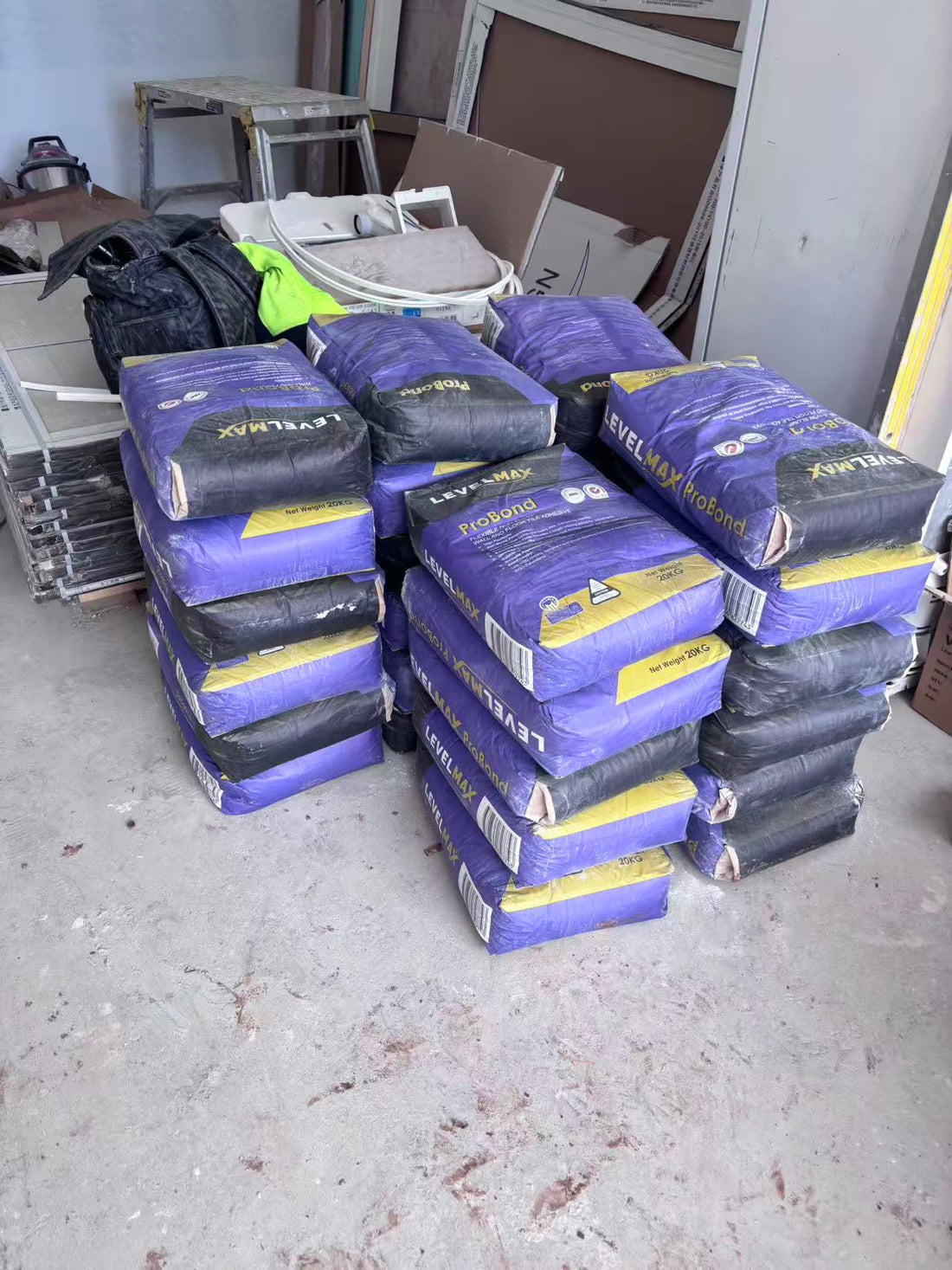
The LEVELMAX ProBond product page lists a C2TE S1 wall and floor tile adhesive in 20kg bags. Request the current TDS and the evidence required by your specification before relying on a classification or selecting an installation system.
1. Confirm the substrate and complete installation system
Describe the substrate and its condition when requesting advice. Confirm preparation, primer, waterproofing, movement joints and the tile manufacturer’s requirements for the proposed system.
A. Concrete and masonry substrates
-
Concrete and cement screeds: Check strength, moisture, flatness, contamination and the required preparation against the current product instructions.
-
Aerated concrete and brickwork: Obtain written confirmation of suitability and preparation for the exact substrate before use.
B. Timber and board substrates
-
Wood and plywood: Do not assume that an S1 description or adding a primer makes a timber substrate suitable. Confirm the complete build-up, movement requirements and written product approval.
-
Gypsum board and drywall: Check the board manufacturer’s limits, the location and the approved preparation and adhesive system.
C. Existing tiles and waterproofing
-
Existing tiles: Assess the existing bond, surface condition and preparation. Obtain written approval for the proposed tile-on-tile system.
-
Waterproofing membranes: Confirm compatibility with the exact membrane and adhesive manufacturers. A general product description does not establish compatibility with every membrane.
2. Read the published product information in context
ProBond is listed as C2TE S1 on the current product page. A classification and an individual laboratory test result are different types of information. Request the applicable report and current TDS for a specification requiring particular adhesion or deformation results.
Product page information to confirm before use
Published ProBond product page information; confirm against the current TDS before use| Item | Published information |
|---|
| Packaging | 20kg bag |
| Mixing water | 5.2L clean water per 20kg bag |
| Open time | 30 minutes |
| Pot life | 2 hours |
| Setting time | 24 hours |
Confirm the required test evidence
-
Adhesion evidence: Where the specification requires a particular result, check the product-specific test method, conditions, report and date. Do not infer water-immersion or heat-ageing performance from a general strength claim.
-
Deformation evidence: Request the test report supporting the stated classification where required. Do not treat a classification alone as approval for heating, movement, exterior work or a particular substrate.
3. Plan application around the site conditions
Use the application instructions for the exact product and allow for the actual site conditions.
-
Product features: Base reinforcement or performance claims on the current product documents and the supporting evidence, rather than assuming a particular formulation.
-
Wall tiling: ProBond is described as non-slump on the product page. Confirm tile size, weight, support and application requirements; this description is not a guarantee that every tile will stay in place without support.
-
Open time: The product page lists 30 minutes. Confirm the current TDS and site conditions, and check adhesive transfer during installation instead of assuming the same working window in every environment.
4. Check demanding applications before specifying
For the following applications, obtain product-specific advice and the written system requirements before ordering:
-
Large-format porcelain: Confirm tile dimensions, backing, required coverage and the selected application method.
-
Underfloor heating: Confirm compatibility and the heating, curing and commissioning procedures with the relevant manufacturers.
-
Commercial areas: Check expected traffic, loading, movement and the complete floor specification.
-
Exterior facades: Obtain project-specific design and product approval for the proposed installation.
A suitable installation depends on the substrate, preparation, tile, adhesive, movement provisions and application conditions together. Use the ProBond product page, the current ProBond SDS and request the current TDS and project advice before use.
The figures above reproduce the current product page for selection guidance. They are not a laboratory report or approval of a particular project.